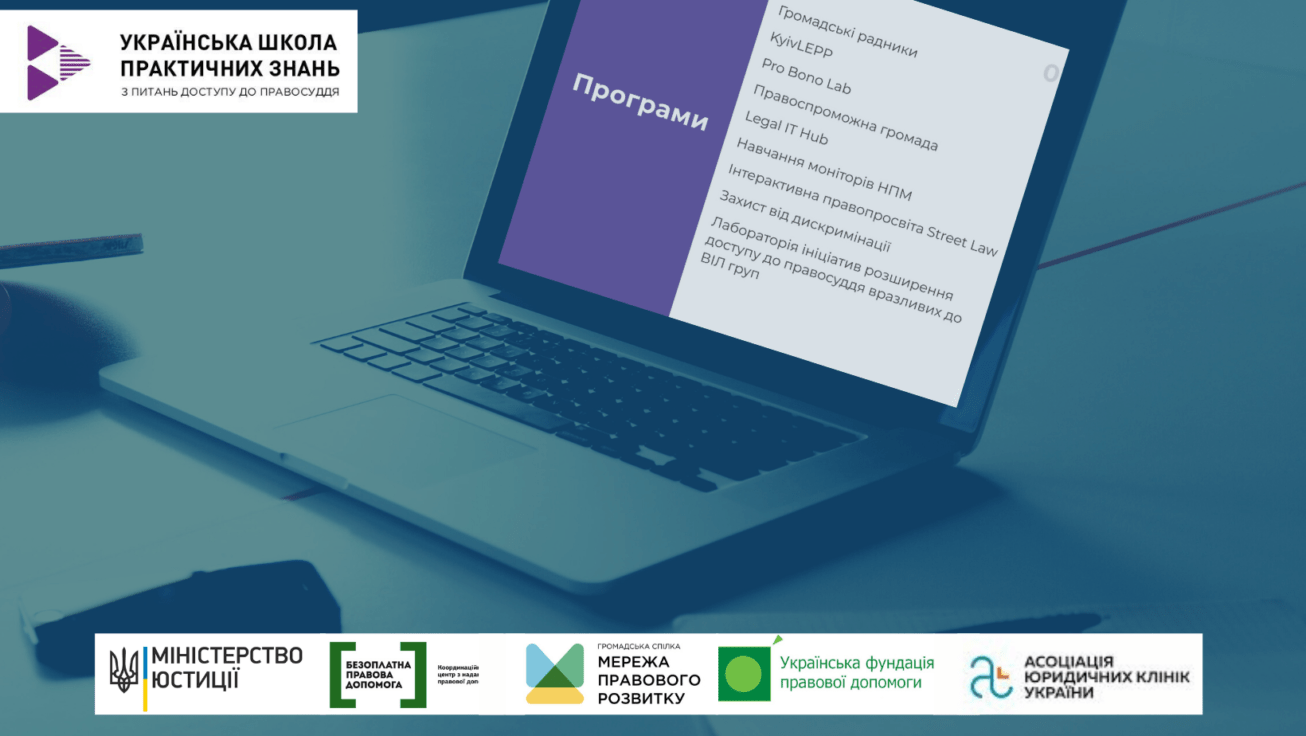
The meeting of the Board of Founders of the School for the first time this year took place on February 18, and it was also joined by the heads of all programs. In the online format, colleagues shared the success of the previous year, as well as jointly made plans for the future.
Iryna Ostrovska, program manager, spoke about the program’s success in the preparations and training of community advisers.
For the eighth set of public advisers, the training program was adapted into an online format. This allowed, despite the restrictions associated with the epidemiological situation, to select 96 study participants, who were combined into three study groups. In December, the first training module was launched. At the same time, a unique training program for mentors among community advisers has begun. Mentors provide expert support to participants of the training during the main course.
“Special gratitude to the School for supporting the mentoring program within the framework of training. Due to the organization of expert support by the School, the content of the program was formed, and its coaching staff was coordinated,” Iryna said.
The desire to participate in the mentoring program was expressed by 75 public advisers, of which 20 were selected. They have already worked out 2 blocks of the program and accompany their mental (wards). In 2021, the program plans to prepare an interactive online course for community advisers and conduct online training.
Kyiv Legal Empowerment Practical Program (KyivLEPP)
Kateryna Yeroshenko, the manager of the Kyiv Legal Empowerment Practical Program, shared the program news, as well as successes in conducting the second training course. She noted that due to participation in the KyivLEPP-2020 training course, five teams in their countries have developed models for solving problems of access to justice:
- Ukraine-Poland plans to create an interactive IT platform for legal clinics in both countries in order to exchange data, study and have a case base with its help.
- North Macedonia introduces a paralegal mobile model to provide legal advice as part of a multidisciplinary team (paralegal, lawyer, social worker, psychologist).
- Another team from North Macedonia will launch an advocacy campaign to prevent the blocking of social accounts by representatives of the Roma local community.
- Kyrgyzstan is working to form a network of paralegals to counter gender-based violence.
- Kenya has already developed an online platform for dispute resolution, so as a result of the training course, it will conduct a campaign to disseminate information about the platform among the population.
Upon completion of the training course, the program together with mentors provides expert support to teams to implement the planned ideas.
Olena Nemchenko, the manager of the Pro Bono Lab Program, spoke about the training course “Legal Empowerment of NGOs” implemented last year, which consists of 10 thematic blocks. The program involved legal experts, including international and Ukrainian companies (KPMG Ukraine, Dentos Kyiv Office, CMS Cameron McKenna Nabarro Olswang in Ukraine, Spensers, Jurobat Law Office, ePravo Law Firm, Oleksiy Pupa & Partners Law Firm, Marynchenko & Partners Audit Firm). 31 social initiatives took part in the training, and another 10 have already applied for the second set.
Also in 2020, for the first time in Kyiv, European Pro Bono Week was held, organized by Pro Bono Lab and the international PILnet network. During the week, lawyers held free webinars for representatives of social initiatives.
The program plans to improve the basic training course, create relevant specialized training video courses for social initiatives from business, as well as establish the process of exchanging expertise of social initiatives for business and society. An ambitious goal for 2021 is to automate the educational process when any participant can be trained at a convenient time and receive a certificate based on the results of training.
Legal empowerment of communities
Yevhen Poltenko, the coordinator of the Legal empowerment of communities Program, also told about his activities in 2020 and plans.
To be brief about the key results of the program:
- 1 adopted local legal aid program
- 4 educational and methodical products
- 4 local legal aid projects
- 4 research of legal needs and problems of community residents
- 4 strategies for implementing recommendations developed based on research
- 12 original publications
- 10 training events (classroom and remote)
- 85 participants of events from 11 territorial communities of 9 regions of Ukraine.
The Program in 2019 focused on advocacy of their previous developments. Based on the results of studies conducted by these groups in 2019, recommendations and plans for their implementation were developed. Therefore, it was on the implementation of these plans that the teams continued to work in 2020. Thus, the Shyroke united territorial community (Zaporizhzhya oblast) organized the work of a mobile group, which managed to attract lawyers and lawyers on a volunteer basis. Prior to the introduction of quarantine restrictions, a mobile point for on-site consultations in rural areas was actively worked, where people do not have access to the Internet and cannot get advice remotely. The program, which was developed by an initiative group from Shyroke, Zaporizhzhya oblast, has already been accepted for implementation by the local council.
In 2021, the Legal empowerment of communities Program plans to improve its methodological base, recruit new participants, conduct a series of webinars on research methodology and conduct research.
At the beginning of 2020, a problem arose that forced all areas of activity to quickly reorient themselves to remote work. According to Mykola Sioma, the manager of the Legal IT Hub, the team has identified its main task – to be an assistant in the process of establishing remote work, to conduct research on the needs of legal aid providers in technological solutions, to find the necessary IT products and to make their presentation to stakeholders.
The program team and its partners conducted a study of modern solutions for remote work in the format of video conferences, formed a list of useful tools for working online and remote webinars. Together with Pro Bono Lab, PILnet, and AVAST, a collection of cybersecurity tips for organizations has been created during the remote work during the COVID-19 pandemic. A master class “Avodocs: quick work with legal documents without errors” was performed, G-suit for Non-profits (a set of integrated Google applications) was analyzed and an instruction guide with an overview of insights was formed. This year, the team intends to make even more useful analytical content (including best practices for the use of technological solutions in the field of access to justice). For this purpose, the needs of the public sector will be studied, the best Ukrainian and foreign practices of the use of technological solutions in the field of A2J (Access to justice) will be monitored.
“We plan to continue publishing materials for the public sector on topics useful for work. We also face an ambitious task – to create a single window for access to free legal aid services from any messenger for vulnerable groups of the population. In addition, we plan to create a joint platform for hosting school training courses. On such a platform, the programs will be able to place their distance courses, and participants will be able to take them, receive appropriate certificates with the logos of organizations that created this or that course,” said Mykola Sioma.
At the same time, Legal IT Hub together with partners will work on creating a landing page for a new program – an international club (International A2J Club), which should become a convenient infrastructure for organizations in the world to quickly and conveniently exchange relevant information and best practices.
Program “Training of monitors of the national preventive mechanism”
At the end of last year, a new program was introduced to the School, which aims to develop a network of monitors of the national preventive mechanism (NPM). Monitors after training will be able to jointly prevent torture and ill-treatment of people in detention facilities.
This year, the program will form and distribute educational media content to raise awareness of the course.
“There has been some development in part of the activities of the national preventive mechanism. In fact, the Commissioner for Human Rights agreed on the format of independent visits of monitors to detention facilities in the regions. This significantly expands opportunities, and on the other hand, poses a challenge: how many monitors in the country, what is their quality of training, how much thematic standards are perceived, what forms of reporting monitors? It also requires discussion and understanding of how to effectively ensure the implementation of the opening opportunities, as well as how to minimize the risks that are intensifying,” commented Roman Romanov, director of the program initiative Human Rights and Justice of the International Renaissance Foundation.
Interactive law education “Street Law”
According to Kateryna Datsko, Program Manager, last year the program team managed to comprehensively explore a new direction for legal clinics – financial services and financial services consumer protection. The first Street Law Festival “FIN $KILLS” was held in the online format, during which interactive lessons were held, the presentation of e-education videos shot by students. In total, legal clinics conducted 120 interactive events in 2020 on financial literacy and consumer protection.
The program has developed 56 infographic educational materials on the protection of human rights in various fields. A guide on “Street Law” was also prepared and published, in which a team of authors collected scripts (notes) for six interactive lessons on financial literacy.
In 2021, the program plans to focus on establishing cooperation with foreign partners, and at the national level the program plans to pilot the concept of mentoring legal clinics. In particular, clinics with experience in conducting educational events on financial literacy can become mentors and help other legal clinics in this topic.
Protection against Discrimination Program
In 2020, the program expanded the network of advocates, advocates against discrimination and hate crimes. More than 20 attorneys who are able to and work with complaints of discrimination and protect clients in the following matters are now working throughout Ukraine:
“Special attention should be paid to the case of a deputy with a disability. For years, he could not perform his duties due to the inaccessibility of the premises in which the sessions of the city council are held. He appealed to the court as the last instance, because he wanted to be heard. Myroslava Anyuk, a graduate of our program, helped the applicant win this case in the first instance – the court confirmed the applicant’s right to a reasonable device, and once again emphasized the inadmissibility of discrimination on the basis of disability,” said Sheilat Afolabi, a member of the program team.
This year, in order to draw more attention to the problem of discrimination, as well as to motivate lawyers to take such cases to work, the program plans to release a series of information materials on the work of graduates of the course.
Laboratory of Initiatives to Increase Access to Justice for HIV-Vulnerable Groups
During 2020, the Lab focused on forming tools to provide people vulnerable to HIV with high-quality legal assistance at the systemic level. Together with the Coordination Center for Legal Aid Provision, a group of mentors was formed and a program of specialized training for them on aspects of protecting HIV-vulnerable clients in criminal proceedings was developed. In addition, to provide high-quality free legal assistance in matters of civil and administrative relations, the Laboratory conducted 5 trainings for 127 employees of the centers for the provision of free legal aid.
In 2021, it is planned to investigate the problems of access to justice of vulnerable populations, to form and publish standards for the provision of free secondary legal aid to vulnerable groups of the population. Also, in 2021, the Program team intends to use various technological means more actively, to create an online tool for access to free legal aid for vulnerable groups of the population, as well as to develop a video course to ensure the possibility of regular training of advocates and lawyers of centres for the provision of free secondary legal aid aspects of work with people who are representatives of vulnerable groups of the population. Over the years, the School has collected a lot of educational and practical content in the field of access to justice (access to justice or A2J). It is in demand not only in Ukraine, but also as demonstrated by the activities of programs, and abroad. At the same time, there is no such platform in the world, yet that would allow different institutions from different countries to exchange experience and best practices for solving A2J problems on an equal basis, to jointly produce educational content. During the meeting of the Board of Founders of the School, the participants of the event noted that the School is now at the stage of existence when it is able to create and ensure the existence of such an international club for communication of institutions of different countries – International A2J Club. The creation of an international club will open access for various organizations to the experience of colleagues from other parts of the world. Among the next steps in joint discussion and coordination of the concept of the club’s activities.