
May month was extremely vivid for this-year participants of the Legally Empowered Community program.* Four webinars are behind, Each team now possesses theoretical knowledge on the topic of Researching Legal Needs of Communities: Providing Access to Justice to be Needed and Effective. Meeting of experts with researches to-be is ahead but off-line to practice gained skills.
Launch of the training under the program in 2020 was described by us in the previous article. Within this time the participants have acquired knowledge in the following topics:
- Concept of access to civil justice and its dimensions
- Research methodology
- Practical aspects of arrangement and conduct of research
- Practical aspects of review and presentation of research findings
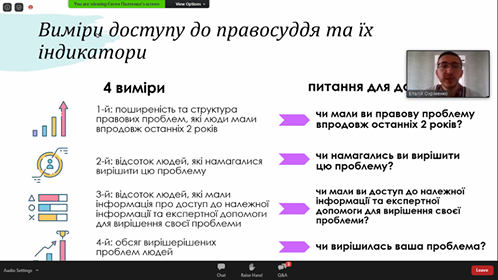
We are going to share with you some interesting theses taken from the presentations of the program experts. With the help of the representative of the Coordination Centre for Legal Aid Provision Vitalii Okhrimenko participants of the program could gain an understanding of such concepts like access to justice:
“Access to justice is a relation domain which is determined by people’s capability to form and improve the law, obtain fair solution to legal issues in conformity with the humans rights standards; if appropriate, through unbiased formal or informal institutions of justice and by means of appropriate legal support which offers the procedurally determined, real, timely, and fair justice. “
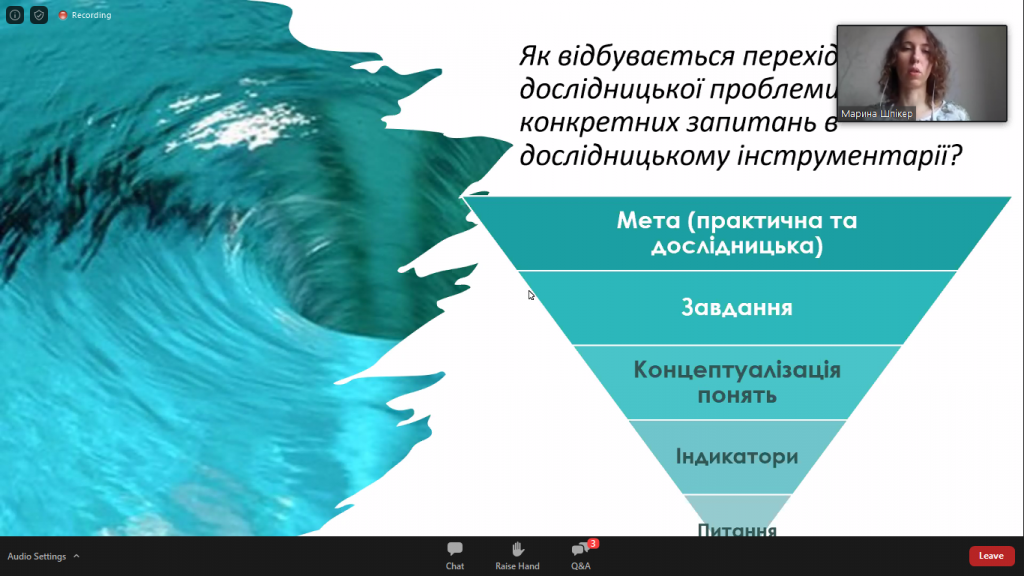
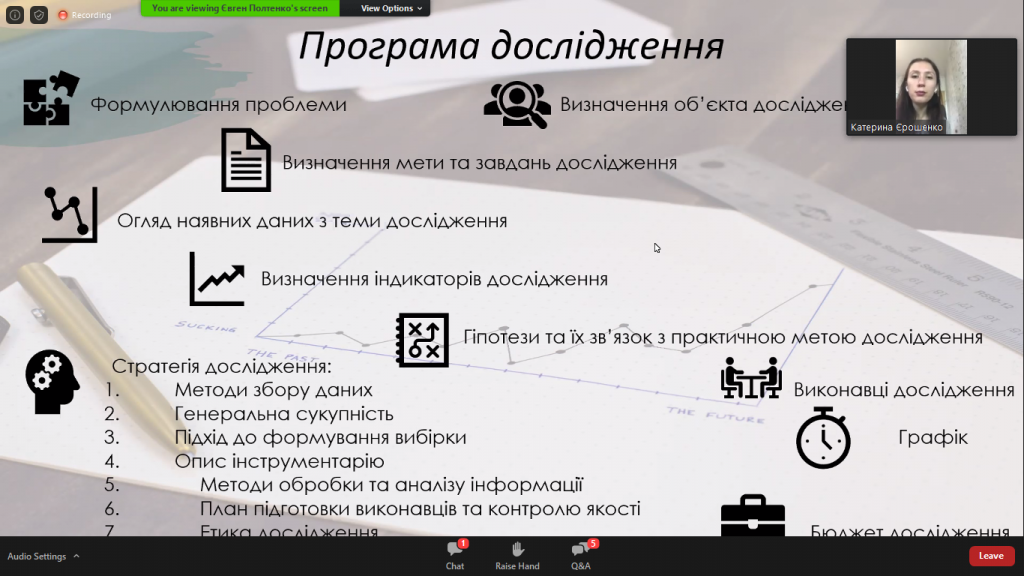
With the help of experts Maryna Shkipe and Kateryna Yeroshenko we have been involved in specifics of conducting research, its essential elements:
- The program and its elements;
- Indicators, hypothesis, and their connection with the practical purpose;
- Use of indicators in tool development;
- Preliminary assessment of available resources and many other things.
Representative of Kyiv International Institute of Sociology Maryna Shpiker detailed every essential issue of the research conduct, one of each is development of tools:
“Before giving particular advice as to what should be noted in the course of drafting questions for your tools, I would like to clarify the main principle to be followed by a researcher: researcher, interviewer and respondent shall understand the question in the same way.
Therefore proper tools have clear definition, contain no ambiguity, perception of it is simple as far as possible, and they are brief.
Development of tools is a task at the border of sociology, cognitive psychology, and linguistics. When developing the tolls you should raise questions to yourself:
– whether the question will be clear to respondents?
– whether the respondent is able to recall what you are asking them about?
– whether the respondent is willing to give frank answer?
– whether the question would cause possible emotional respond?No researcher is able to forecast for sure how their wording will be acquired by respondents. That is why the tools are required to be tested before research.”
The main thing after research will be conducted is presentation of its findings, since the information obtained must be useful and facilitating to real changes. Therefore we have put this issue under separate discussion.
“As practice goes (as well as experience of many participants, more likely), even the most useful at the first glance research with the findings that may have effect on life of the community/city/region/millions of people, may be easily disregarded and failed at the presentation stage: improper approaches, techniques and means, and, sometimes, even time and place of presentation”, Project Expert Kateryna Yeroshenko highlighted.
Executive Director of Legal Development Network public union and Coordinator of the Legally Empowered Community program Yevhen Poltenko shared his impressions about outcomes of the first program module:
“We have scheduled our training events far ago in pre-lockdown times. Situation with the pandemic has transformed our plans. I am highly proud of the respond by the expert team thereto, how fast we managed to bring our training in on-line mode. I am grateful to the teams that have been actively involved in the process and successfully overcome all challenges of remote training. We did our best and look forward to the off-line meeting in a week in Kyiv.”
* Legally Empowered Community training practical program (hereinafter, the Program) provides a unique opportunity for the Ukrainian communities to schedule, prepare and conduct research of the residents’ legal needs.
The program has been implemented by the Ukrainian School of Practical Knowledge on Access to Justice since 2019 and direct administration of the PRAVOKATOR Legal Clubs network backed by the partner organizations and institutions as follows: International Renaissance Foundation, Ukrainian Legal Aid Foundation, and Coordination Centre for Legal Aid Provision. See more details: https://bit.ly/2u5F03X